Taken from my two articles written for the Pennant, magazine for the Pen Collectors of America: 2023 issue 1, and 2023 issue 2.
In Part 1, I traced the migration of the various Richard Esterbrooks and family from Cornwall to Canada, eventually to end up in Camden, New Jersey. The company they founded was called R. Esterbrook and Company. It formally filed for incorporation in 1860 with warehouses and offices listed as 403 Arch Street in Philadelphia. The company was listed as having three partners: Richard Esterbrook Sr., Joel Cadbury Jr., and James Bromsgrove. Richard Esterbrook Jr. was listed as an officer of the company, but not a partner.
Joel Cadbury Jr. was the son of a prominent Philadelphia merchant who owned a dry goods store at 252 Franklin Street. Joel Sr. was also on the board of a local canal company and his brother ran a pharmacy in the same store on Franklin. The Philadelphia Cadburys, like the Birmingham Chocolate Cadburys, were Quakers in good standing (along with the Esterbrooks, as we learned in the first part of the story.) They were logical partners for Esterbrook because they had connections, access to money, and an extensive knowledge of the local business community.
James Bromsgrove’s contribution to the partnership was that he came from Birmingham, England, and had been in the steel pen business for a couple of decades. We first encounter him in the Birmingham city directories as a young man boarding in the house of a tool maker in 1841. By 1845 the directory of Birmingham lists him as a “steel pen manufacturer, [at] 13 & 14 Cumberland St.” In the same 1845 directory, he is found in a list of “Steel Pen Manufacturers” where we also find his presumed partner Alex Cope at the same address. He is listed along with other steel pen manufacturers like Gillott, Hinks & Wells, and John and William Mitchell.
Bromsgrove is most likely the person referred to in an early mention of the company in the October 5, 1861, issue of Scientific American, v.1005 (emphasis mine): “A new steel-pen factory has been established in Camden, N.J., by R. Esterbrook & Co., who, having secured the services of some of the best pen makers of the old world, and one of the firm having twenty years’ experience in the business, expect to manufacture an improved and superior article. It is supposed that Birmingham will be obliged to yield the ‘champion quill’ to Jersey.”
There are consistent reports over the years that James Bromsgrove was not the only English pen maker from Birmingham brought into the Esterbrook company. The story is that, just as with Washington Medallion, Richard Esterbrook brought a few English tool makers from Birmingham to help him set up his new factory along British lines.
For a long time, the only one I could confirm with any certainty was John Turner. Turner went on to head up Warrington & Co. in Philadelphia, and then joined with another Birmingham toolmaker brought over to start up another US factory (Washington Medallion Pen Company), George Harrison to found the second largest pen maker in the US, Turner and Harrison.
I recently found an article from an issue of The Sunday Mercury from Birmingham, England. In Nov. 13, 1960, the paper published an article “Five Men With a Mission Founded an Industry.” In it they talk about five men from the John Mitchell pen works who Richard Esterbrook convinced to come to US to help him found his factory. Their names are John Weintz, Frederick Hill, William Baker, George Beasley, and John Fenimore. Amazingly enough, two of John Weintz’s decendents still worked at Esterbrook, on in the old John Mitchell works which Esterbrook bought after WWII to make pens in England, and one in the New Jersey works. But that’s getting ahead of ourselves.
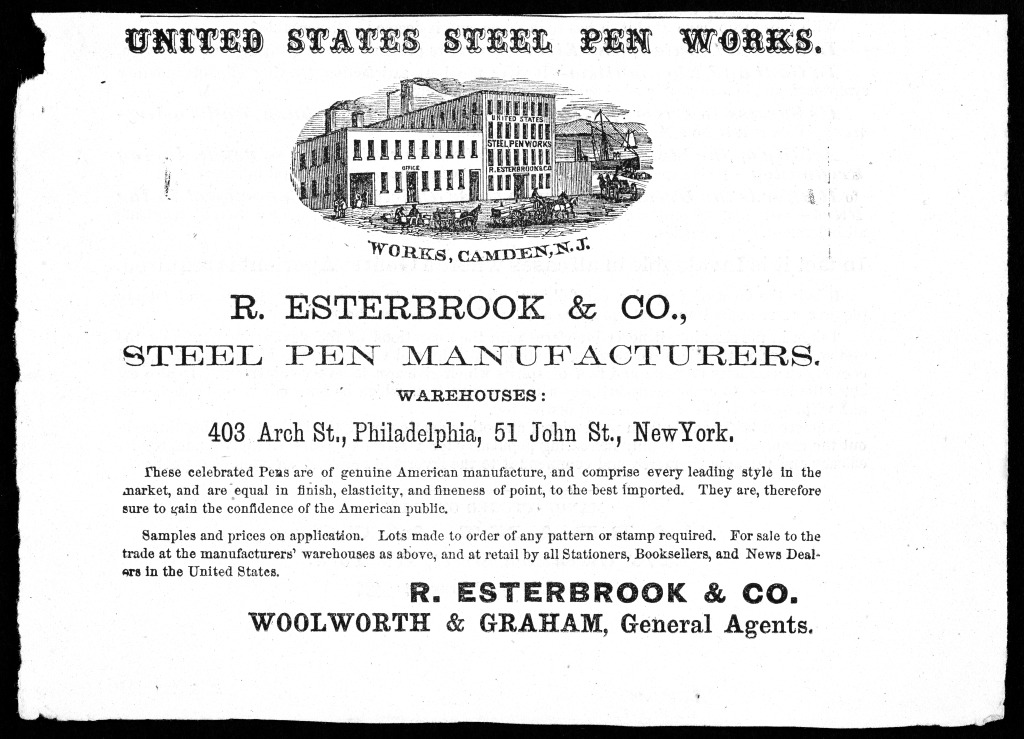
The factory itself was the former Camden Water Works on Cooper St. and was located on a lot that was then on the river, but is now between Front St. and Jersey Joe Walcott Blvd. The factory remained there, in the middle of the block on the south side, from its opening in 1861 until the company finally moved the operations over 100 years later to Cherry Hill, New Jersey. They named the factory the United States Steel Pen Works.
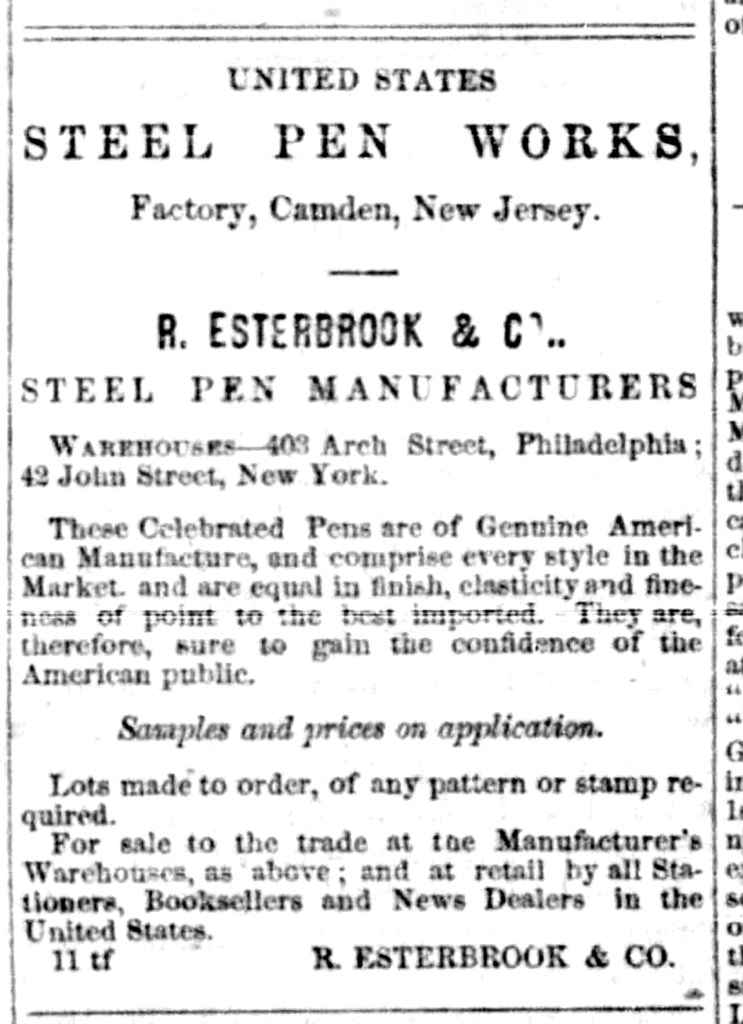
We have very little evidence for what the company was like in these earliest years from 1861 through 1866. We do know, from directories, that its original warehouse was in Philadelphia at 403 Arch St., and, at least in 1861, an office at 16 North 5th St. in Philadelphia. Not long after, the offices moved to New York City. The New York City office moved around to various locations quite a bit, which helps us roughly date ephemera that often included the office location but no date. (see “Dating Esterbrook Ephemera”)
It’s not clear just when R. Esterbrook and Company opened its first offices in New York City, but on May 9, 1865, an advertisement appeared in the New York Daily Herald asking for the return of a pocketbook lost in New York City by Richard Esterbrook. It contained certificates for several hundred shares of various stock, as well as checks and currency worth over $1,000. The pocketbook could be returned to Richard Esterbrook at 42 John Street for a reward. It was also in 1865 that we see Richard Jr. along with his wife, Jeannette E., young son (named Richard Esterbrook, of course), and newborn daughter, Jeannette H., moving to Long Island to take over the New York office.
We do see that from the very first year, the Esterbrooks were big believers in advertising. The earliest mention of Esterbrook I have dates to that first year of 1861. It is an article in the West-Jersey Pioneer of June 22, 1861, that announced a pen factory had been started up in New Jersey. The unnamed writer commended any attempts at increasing American independence of foreign articles of this type, especially as it looked like the country was soon to enter a possibly protracted war (the American Civil War), which could result in the strangling of trade with England. The writer urged readers to support such a company and hoped that it would be successful.
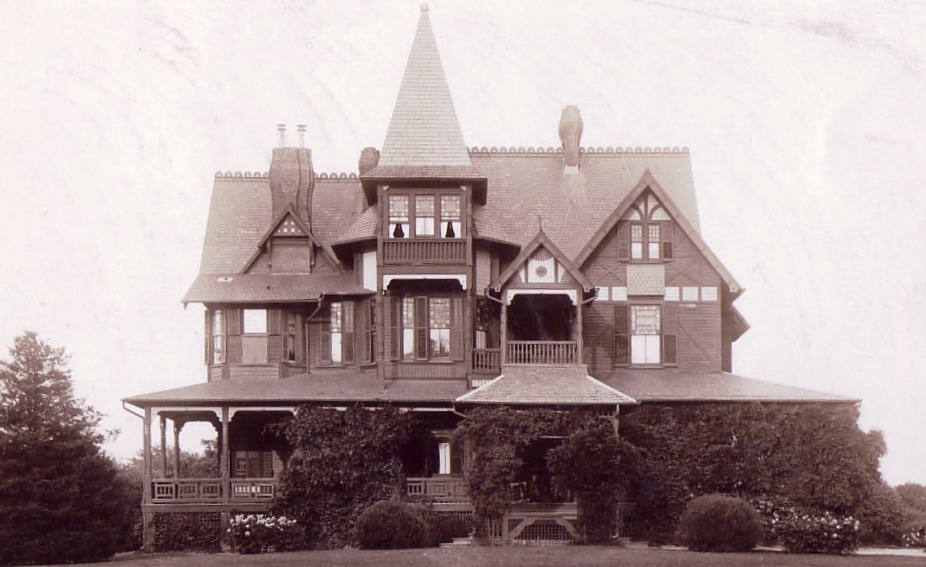
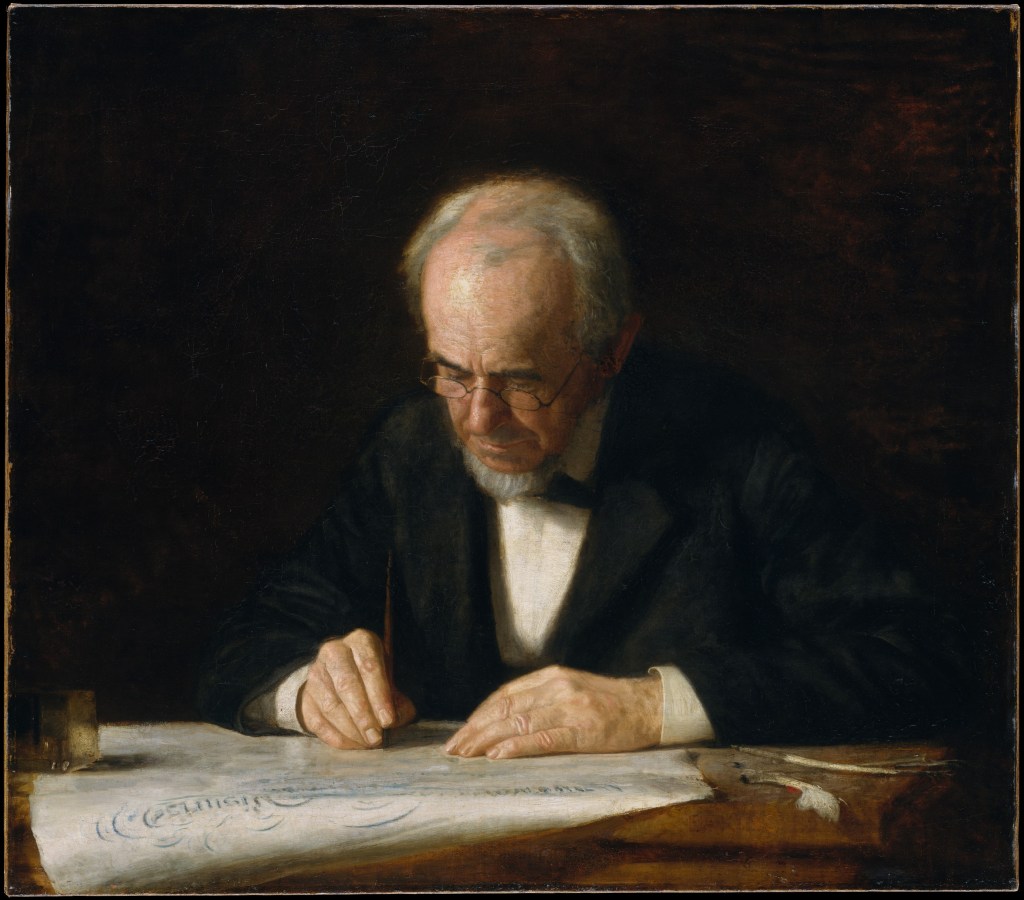
The earliest advertisement yet found is from just a month or so later, in July 17, 1861, in the same newspaper. The article includes testimonials to the quality of Esterbrook’s “full assortment of pens” from a long list of merchants and one writing teacher, Benjamin Eakins. Benjamin Eakins was also the father of the famous painter Thomas Eakins, whose portrait of his father, The Writing Master, currently hangs in the Metropolitan Museum of Art
Here is the Thomas Eakins painting in the Met, showing his father, Benjamin whose name appears in Esterbrook’s first advertisement.
The pens were not just selling locally in Philadelphia and western New Jersey. In the Nov 26, 1862, issue of the Detroit Free Press, a stationer in the “western” city of Detroit, Michigan, advertised “a well selected stock of Esterbrook’s writing pens” for sale. During the Civil War, Esterbrook was not slow in getting their pens wherever they could as the southern states opened up to trade with the North. By 1864, the pens were even making it as deep into the south as Vicksburg, Mississippi. Less than a year after the siege and capture of Vicksburg by the Union Army, and while the war continued in other southern states, a local stationer advertised in the June 9th issue of the Vicksburg Herald a selection of “Esterbrook and Gillott” pens for sale. And by 1865, you see advertisements in former confederate cities such as Charleston, South Carolina; Nashville, Tennessee; and New Bern, North Carolina; in addition to New York City and surrounding states. And just the next year, in 1866, advertisements were appearing in as remote of a place as Prescott, the new capital of the Arizona Territories, where an ad was placed in the Arizona Miner newspaper of August 8, 1866.
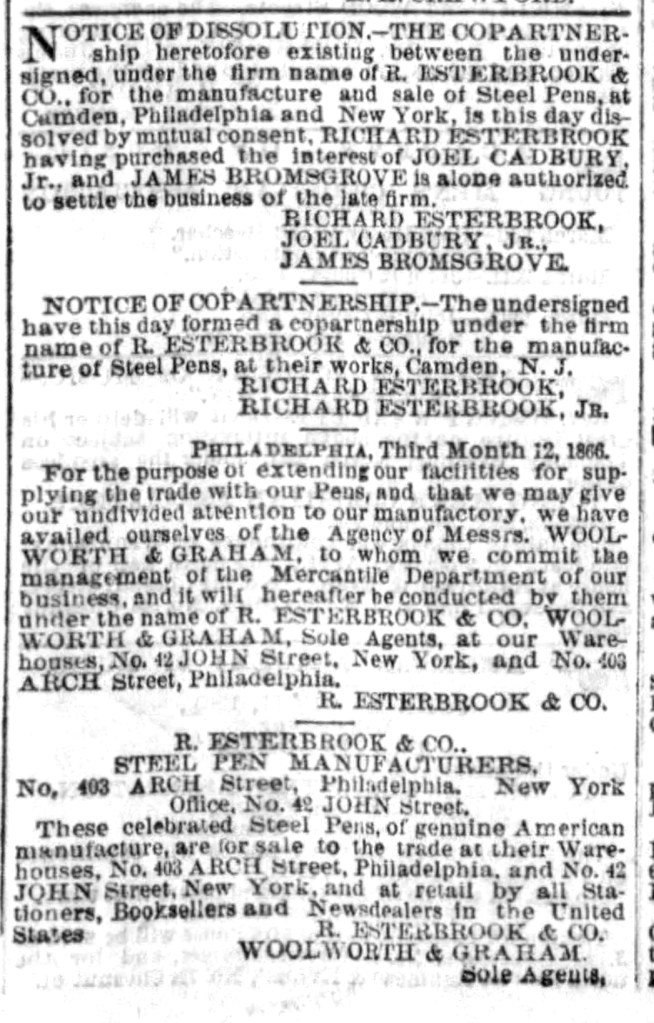
We get our first inside look of the company operations in 1866, a significant year for the Esterbrooks. It seems that by this point, Senior felt the company was established enough to make some significant changes and fully commit to this American experiment. On March 12th of that year, “Senior,” as Richard Sr. had come to be called, bought out his original partners, Cadbury and Bromsgrove, and officially dissolved the partnership. He then re-established R. Esterbrook and Co. as a co-partnership with his son, Richard Junior (“Junior”). We find this announcement in many papers like this one.
In these first few years of the company, Senior had not fully cut his ties to the old country. He remained politically active in Cornwall. He signed petitions, such as the one in 1858 promoting parliamentary reform and voted in the local elections in Liskeard in at least 1861, 1863, and 1864, listing Dean Terrace as his address. It wasn’t until 1866 that he seems to have finally decided to commit to this new endeavor and new country. In that year, he sold his Liskeard house and his stationery shop (the deed, dated June 6, is in the Liskeard Museum), and restructured the pen business to make R. Esterbrook & Co. a family affair.
In the next decade or so the company grew tremendously, while also encountering some serious trials and tribulations, including two lawsuits for trademark infringement. In 1868, the newly reformed Washington Medallion Pen Company (see my article on “The Washington Medallion Pen Company: Part II,” Pennant, Fall 2022) sued Esterbrook for several trademark infringements, winning an injunction against using a similar style of nested boxing (twelve “dozen” boxes inside one “gross” box); stamping a head in profile on pens and surrounding it with a rim thus making a medallion; making labels that looked like the Washington Medallion pen labels; and printing on them the phrases “Let Americans Write with American Pens” or “Our Country Now and Forever.”
This law suit was seen as important enough for understanding the emerging trademark laws for the New York Times (December 3, 1868) to publish a short article detailing the case as an illustration of how the courts were now ruling on trademark infringement: “As there are some features of this injunction that are of great interest to all manufacturers who have marks or indicia to protect, and to merchants who, by buying and selling goods under simulated names and labels may, unconsciously may participate in the perpetuation of frauds.”
In 1872, Gillott brought a separate lawsuit against Esterbrook for using the designations “404” and “303” for its school pens and fine-point pens respectively. The Gillott 404 and 303 were two of the best-selling pens in the United States, and two of Gillott’s most popular. Esterbrook then re-numbered its versions of the pens to “444” and “333.” We see an interesting transitional salesman’s sample book in the collection of David Nishimura where the card shows the new number, 444, but the pen tied to the card still has the old number, 404, on it (see Esterbrook #444). This allows us to date this sample card to soon after the judgment. Esterbrook could sell only the new numbers but still had some old stock they could use on sample cards to show the shape and size of the pens.
The 1870s were a difficult time for many businesses. There was a major national depression from 1873 to 1879, called the Long Depression, and we can see that Esterbrook was not immune. The Boston Globe, on February 2, 1876, wrote that “[t]he reported failure of the Esterbrook Steel Pen Manufacturing Company of 26 John St., is said to be only a temporary embarrassment, and arrangements will be made in Camden, N.J. tomorrow, for a resumption of business. The capital of the Company is $2,000,000, and the concern is said to be perfectly solvent.”
Overcoming its business hardships, Esterbrook was the only US steel pen maker to display at the 1876 Centennial Exhibit in Philadelphia. Volume 1, 1876, p. 381 of the trade publication American Bookseller notes that in the exhibition hall, they [Esterbrook] “occupy a large wall space on which they make an exhibit of their various pens. The wall is covered with black velvet, upon which the pens are arranged in various geometrical figures, according to their grades. The entire design of the exhibit is highly artistic, and has already attracted much attention. In the centre of the space the various colored bronze, silver and gilt pens are arranged about a common centre, like rays of light, and the sunbeams shining upon their polished surfaces make a most striking effect.” There were plenty of styles of pen to choose from. In the 1876 Illustrated Price-List of the Esterbrook Steel Pen Co., you can find 118 different styles of pens, many in different finishes, including gray, silver, gold, black, and even copper, and 28 different holders.
These kinds of pen displays were common in international exhibitions of the later-half of the 19th-century. You can still see some intact ones at the Pen Museum in Birmingham.
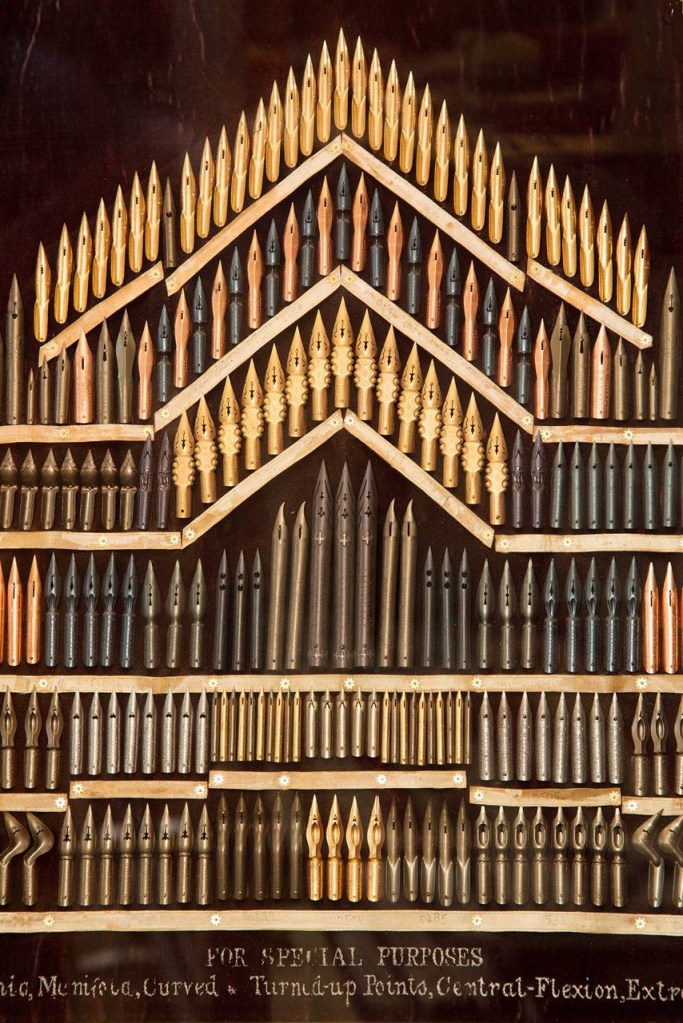
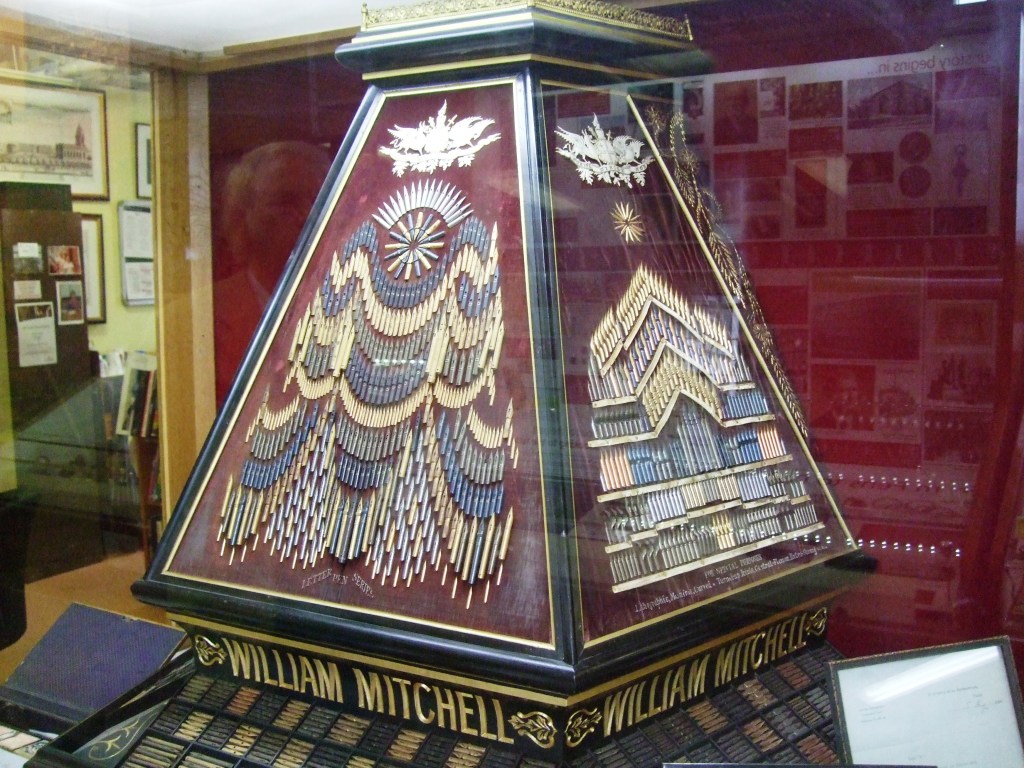
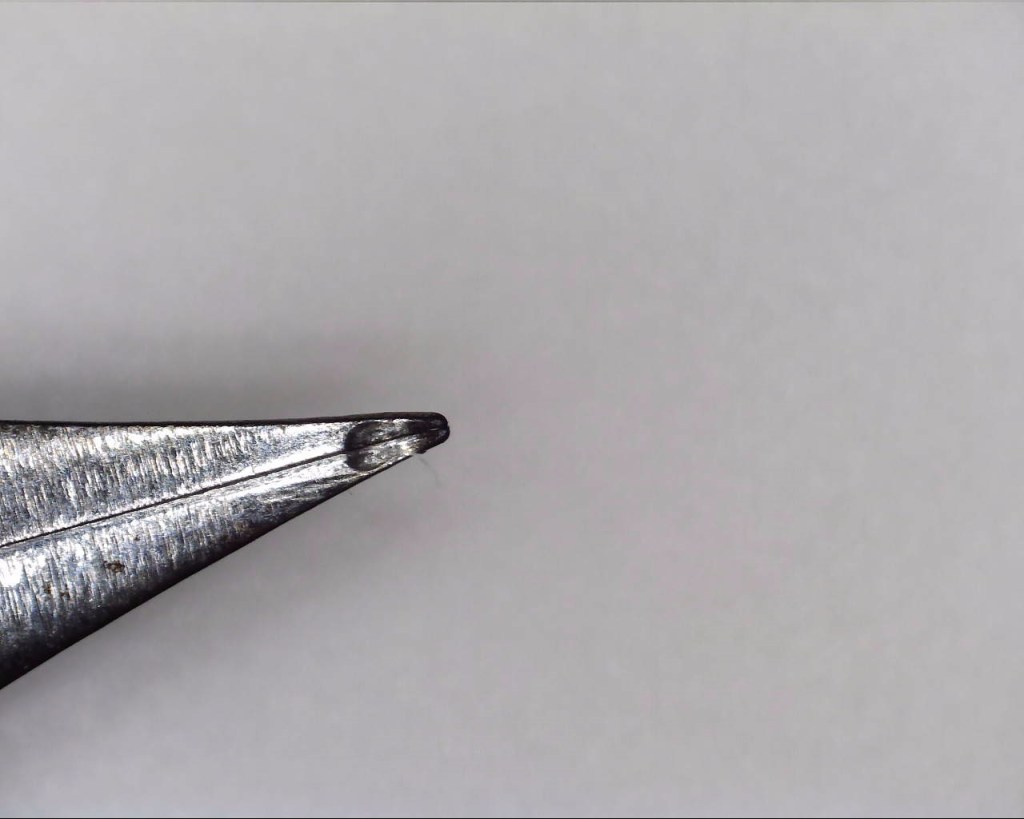
The 1870s and ’80s were also a time of innovation and expansion for the company. Esterbrook’s line of pens and holders increased in size, and the company came out with innovative new types of pens including its first stub tip, the no. 161 in 1871, and its first turned-up tips, the no. 1876 Telegraph, no. 280 Tecumseh, and no. 309 Choctaw pens. The stub and turned-up tip were solutions for the common problem that sharp-pointed pens pose for people who need to write a lot and write quickly: a pointed pen may write a nice line, but it is slow. The stub was the first solution, developed in England in the 1830s, and these were always popular.
The turned-up tip was the second step in this evolution, in which the sharp tip is bent at an angle so the flat surface lies on the paper. This eventually led to other solutions including ball/oval tips where a small, round indent was made at the very tip to create a smoother, round writing surface to replace the sharp point of earlier pens. These first “ball point” pens had many names and became some of the most popular styles in later years, when writing with great line variation was not as important. Esterbrook’s most popular style of this type was the no. 788 Oval Tip, many of which are still to be found today.
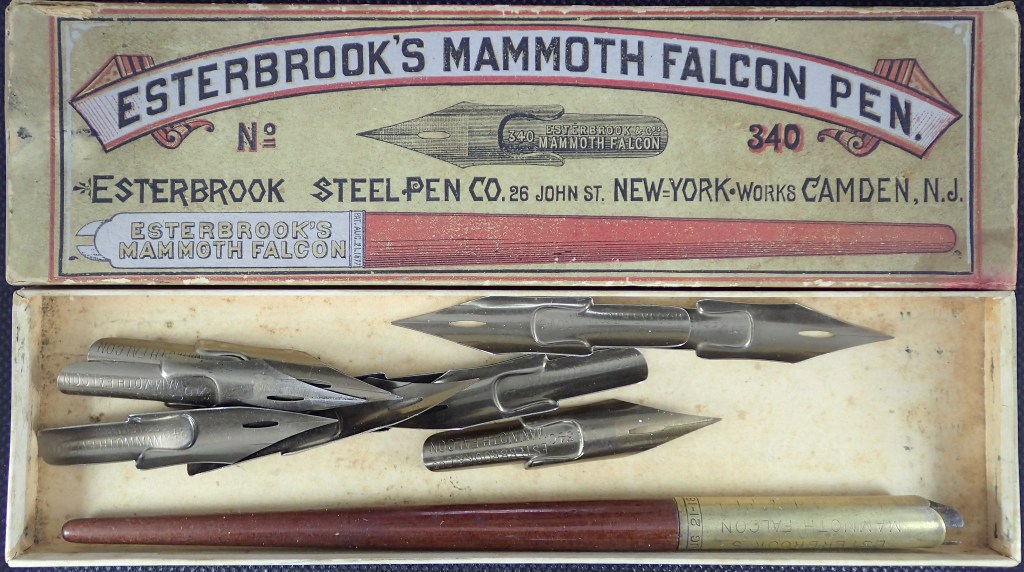
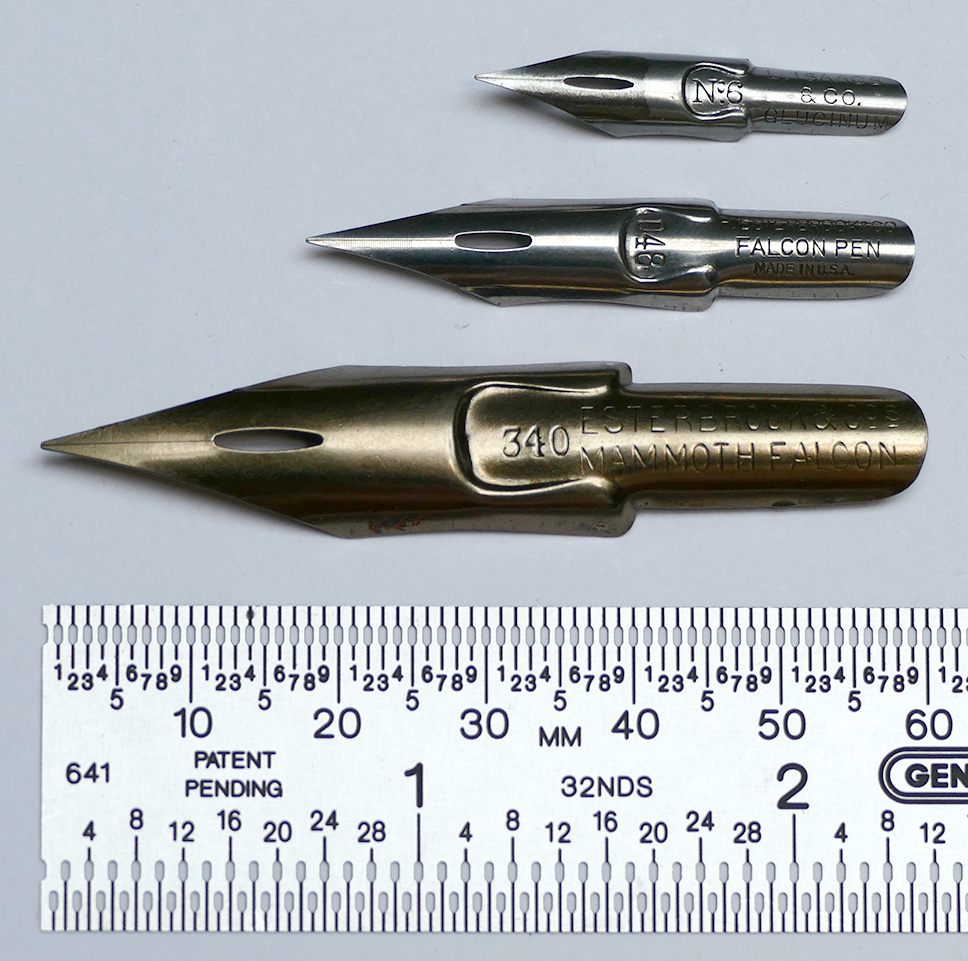
This period also saw the introduction of many new styles, including the No. 340 Mammoth Falcon Pen, a huge version of their most popular pen, the no. 048 Falcon pen brought out by Esterbrook at least as early as 1865, and consistently their best-seller. The Mammoth is a very large pen that required a special holder and borders on the size of a novelty pen. To use one, the writer must hold their hand so far back from the tip that it can be difficult to hold except at a very low angle. It does hold a great deal of ink but is not terribly practical for everyday use.
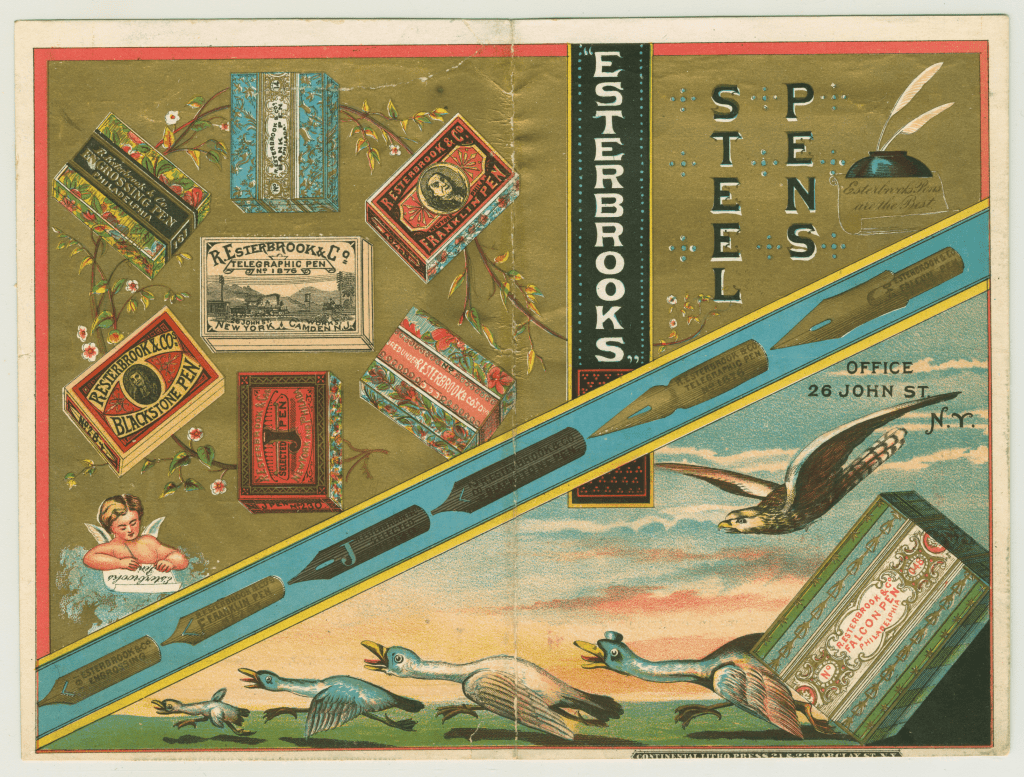
Throughout this period, Junior, as head of sales, was quite active in ensuring Esterbrook’s name was seen everywhere. The company spent a great deal on advertising and you find their ads in a wide variety of publications. Esterbrook also jumped on the bandwagon of trade cards, which were all the rage at this time. The 1880s trade cards seen in figure 12 are superior examples, with the modern falcon pens shown chasing away the old-fashioned geese, representing quills.
The 1890s saw many changes at the company. Richard Jr. died in 1892, followed by his father three years later in 1895. Francis “Frank” Woods took over as the new president of the company upon the death of Richard Sr. Frank had started at the company as a salesman and came from an established Quaker family in New Jersey and New York. In 1868, he had married Mary Anna Esterbrook, daughter of Richard Sr. and Mary R. Esterbrook. He worked his way up through the company, eventually becoming vice president. He served as president until his death in December 1909.
Upon Frank’s death, the presidency was taken over by another son-in-law, John Henry Longmaid, the husband of Richard Jr.’s daughter Jeanette. The Longmaids were originally from Liskeard, the same town in Cornwall where the Esterbrook family originated. John Henry’s father, also John, a contemporary of Richard Jr.’s, moved his family out to Montana to manage a British-owned mine about the time the Esterbrooks moved to the United States. The families must have kept in touch, as John Henry and Jeanette were married in 1891, at which time he joined the company. After he passed away in 1930, his son Sidney Longmaid took over as president. Sidney was the last relation of Richard Esterbrook to run the company. He was still running the company when the article about the five men from Birmingham mentioned above was published in 1960.
The Esterbrook Steel Pen Manufacturing Company continued to make pens in Camden at the original site. They also built factories in Mexico City and Toronto in addition to other locations within Camden to augment the Cooper Street location. Esterbrook purchased the John Mitchell pen works in Birmingham and reopened the factory as Esterbrook Hazel Pens Ltd. in 1944.
During World War I, Esterbrook had reduced the number of styles produced down to just 30. After the war, many of the discontinued styles did not come back as the popularity of fountain pens continued to rise. Esterbrook ceased all steel pen manufacturing in 1952 and focused on the fountain pen business. For nearly 100 years, R. Esterbrook & Co. dominated the American steel pen market. The quality of its pens, its extensive advertising and sales efforts, and the business savvy of the extended Esterbrook family kept them on top throughout the golden age of steel pens.
 ©The Esterbrook Project